Building Your Sales Engine
A show where Mark McGraw, a top Sandler Sales Trainer and David H. Sandler award winner, interviews salespeople and sales managers to discover their successes and how they got to be the people they are today.
We break down the elements of selling success and share mindsets, habits and techniques that help salespeople and managers build a proven, reliable, transferable system for sales.
All Episodes
Prospecting Is Not Urgent Until It Is: Build the Consistency Habit
Sales prospecting is never urgent until your pipeline is empty — Mark McGraw and Josh Pitchford break down the habits, blocks, and manager moves that make prospecting consistent before it becomes a crisis. Sales prospecting is the number one constraint sales teams name year after year, and Josh Pitchford's line explains exactly why: "Prospecting is not urgent until it is." In this episode, Mark McGraw and Josh dig into the creative avoidance that keeps sellers busy with everything except finding new business — and what actually breaks the cycle. Josh walks through the group prospecting model he runs with clients: dedicated phone camps and power hours, sellers paired up in round robin so everyone listens and learns, and a 15-to-30-minute debrief that celebrates the work, not just the wins. The numbers speak for themselves — 600 dials, 100 conversations, 20 new meetings in a single day. Mark adds the individual side: reduce friction so your block is execution time and not prep time, treat the start like an F1 green light, and remember that building a list is not prospecting. You'll also get the behavioral triggers that get sellers moving — pulling future pain into the present, the "just do one" rule, and the Pomodoro 25-minute sprint with notifications off. And for sales leaders, Mark shares the no-fly zone: protected calendar hours where no internal meeting can touch prime selling time. Host: Mark McGraw — Building Your Sales Engine Co-host: Josh Pitchford — Building Your Sales Engine In This Episode Why prospecting sits in the "important but not urgent" box — and what happens when it finally turns urgent Creative avoidance: the honest exercise of naming what you do instead of prospecting Phone camps and power hours — how to structure blocked prospecting time that teams actually show up for The workout-buddy effect: why prospecting alongside someone beats sitting alone with a list of 25 names Round robin calling, real-time debriefs, and how tonality and posture cross-pollinate across a team Celebrating the process, not just the results — 600 dials, 100 conversations, 20 meetings Reducing friction so your block is execution, not "getting ready to get ready" Behavioral triggers that start the engine: future pain in the present, "just do one," and the Pomodoro 25-minute sprint Fat and happy, lumpy sales, and why your convictions are only as strong as your pipeline No-fly zones: how sales leaders protect prime selling hours and go to bat for their team Links Sandler: https://www.Sandler.com Episode page: https://www.BuildingYourSalesEngine.com/ Show links: https://linktr.ee/buildingyoursalesengine Mark McGraw on LinkedIn: https://www.linkedin.com/in/markmcgraw/ Josh Pitchford on LinkedIn: https://www.linkedin.com/in/josh-pitchford-6163274/
Getting Your CS Team to Sell /w Steve Popp
Getting your CS team to sell starts with mindset, not skill — Steve Popp breaks down how customer success and service teams are being handed revenue responsibility, and how to make the transition stick. Getting your CS team to sell is one of the biggest shifts happening in sales right now. Revenue responsibility is moving away from traditional selling roles and landing on customer success, customer service, account management — even engineering. In this episode of Building Your Sales Engine, host Mark McGraw sits down with Sandler's Steve Popp to unpack why organizations are doing it, why it works, and where it breaks down. Steve explains that CS professionals are often *better* positioned to expand revenue than salespeople. They have more touch points, deeper rapport, and a level of trust you simply can't buy. What they don't have is the expectation, the skill set, or — most importantly — the mindset. Steve boils the transformation down to four buckets: strategy, operations, talent, and enablement, and argues that leaders should control the controllables and start with the one thing they own: their people. Mark and Steve get practical about the fear that shows up in every room — fear of cold calls, fear of not knowing the answer, fear of the word "sales" — and share the reframes that dissolve it: qualification as a two-way street, and selling as service. As Mark puts it, "I'm calling to see if they have problems that I have medicine for." About Steve Popp Steve Popp is a member of the Sandler team and a longtime collaborator of Mark McGraw's — and, notably, the show's first-ever guest back when he was a client. Steve works with CROs, CEOs, and COOs navigating the shift of revenue responsibility into client-facing service roles, helping them align strategy, operations, talent, and enablement. His core conviction: will before skill, mindset before technique. Connect with Steve on LinkedIn: https://www.linkedin.com/in/stevejpopp/ Host: Mark McGraw — Building Your Sales Engine Guest: Steve Popp — Sandler In This Episode Why revenue responsibility is shifting from traditional sales roles to customer success, service, and account management The four buckets of every CS transformation: strategy, operations, talent, and enablement Why CS people are uniquely qualified to sell — more touch points, deeper problem-solving, and trust you can't buy "Head trash" and the mindset barrier: will first, skill second How we got here — all-hands-on-deck revenue pressure and the hunter/farmer split "We moved the cheese on you" — leading people through a change they never asked for, including the reality that you may lose talent The fears that surface in every room: cold-call reluctance, process anxiety, and "what if they ask something I don't know?" The qualification reframe that takes the pressure off — they have to qualify to you, too Selling as service: "problems that I have medicine for," and why not reaching out is a disservice Why this is a two-to-three-year initiative, not a two-month one Links Sandler: https://www.Sandler.com Episode page: https://www.BuildingYourSalesEngine.com/ Show links: https://linktr.ee/buildingyoursalesengine Mark McGraw on LinkedIn: https://www.linkedin.com/in/markmcgraw/ Steve Popp on LinkedIn: https://www.linkedin.com/in/stevejpopp/
Recognizing Head Trash Cures 70% of Your Selling Problems
Head trash — the self-limiting beliefs salespeople carry — quietly kills more deals than any competitor, and simply recognizing it cures about 70% of the problem. Head trash is the psychological baggage salespeople drag into every call, and it costs more revenue than any pricing objection ever will. In this episode, host Mark McGraw sits down with co-host Josh Pitchford to work through a list of 55 self-limiting beliefs they've collected over years of sales training — everything from "the economy is bad and my prospects don't have money" to "I can't close on the first call" to "I need my prospects to like me." Mark and Josh unpack why these beliefs are so durable: the Belief Wheel means your beliefs shape which evidence you notice, which drives your actions, which produces results that reinforce the original belief. Breaking the loop takes two moves — find evidence someone has already done the thing you think is impossible, or act in spite of the feeling and let the results retrain your thinking. Along the way they cover money head trash and the childhood messages behind it, why the budget conversation only fails when it's too early or too late, using a monkey's paw to get paid for services you're currently giving away, and why Need for Approval unpacks a thousand selling problems at once. Practical, honest, and occasionally uncomfortable — in the best way. Host: Mark McGraw — Building Your Sales Engine Co-host: Josh Pitchford — Building Your Sales Engine In This Episode What head trash actually is — psychological baggage and self-limiting beliefs that get in the way of selling more, and why it's part of the human condition "Is it a budget issue or a belief issue?" — why buyers with enough pain find the money, and why the seller has to believe first The Belief Wheel: how beliefs filter evidence, evidence drives action, and results loop back to reinforce the belief Two ways to break a limiting belief — find evidence someone else has already done it, or act in spite of the feeling and let results follow The four-minute-mile effect: the wealth manager who never closed on a first call, then went from 0-for-20 to 7-for-20 Monkey's paw selling — using small commitments to shorten long cycles, and getting paid for the design, survey, and assessment work you're giving away free Money head trash: the childhood messages ("don't talk about money, it's rude") that are still running 30 years later, plus John Rosso's rule on timing the investment step Why a salesperson is a problem solver — and why it's irresponsible to withhold a solution to a problem you know someone has Access to power: how not feeling "worthy" to talk to executives reads as a lack of conviction and loses the business Need for Approval — "I need my prospects to like me" — and how it quietly kills prospecting, questions, and asks for commitment Head trash is like cockroaches: turn the light on and it scurries Links Sandler: https://www.Sandler.com Episode page: https://www.BuildingYourSalesEngine.com/ Show links: https://linktr.ee/buildingyoursalesengine Mark McGraw on LinkedIn: https://www.linkedin.com/in/markmcgraw/ Josh Pitchford on LinkedIn: https://www.linkedin.com/in/josh-pitchford-6163274/ Download the list of 55 Head Trash items referenced in this episode — available via the show links above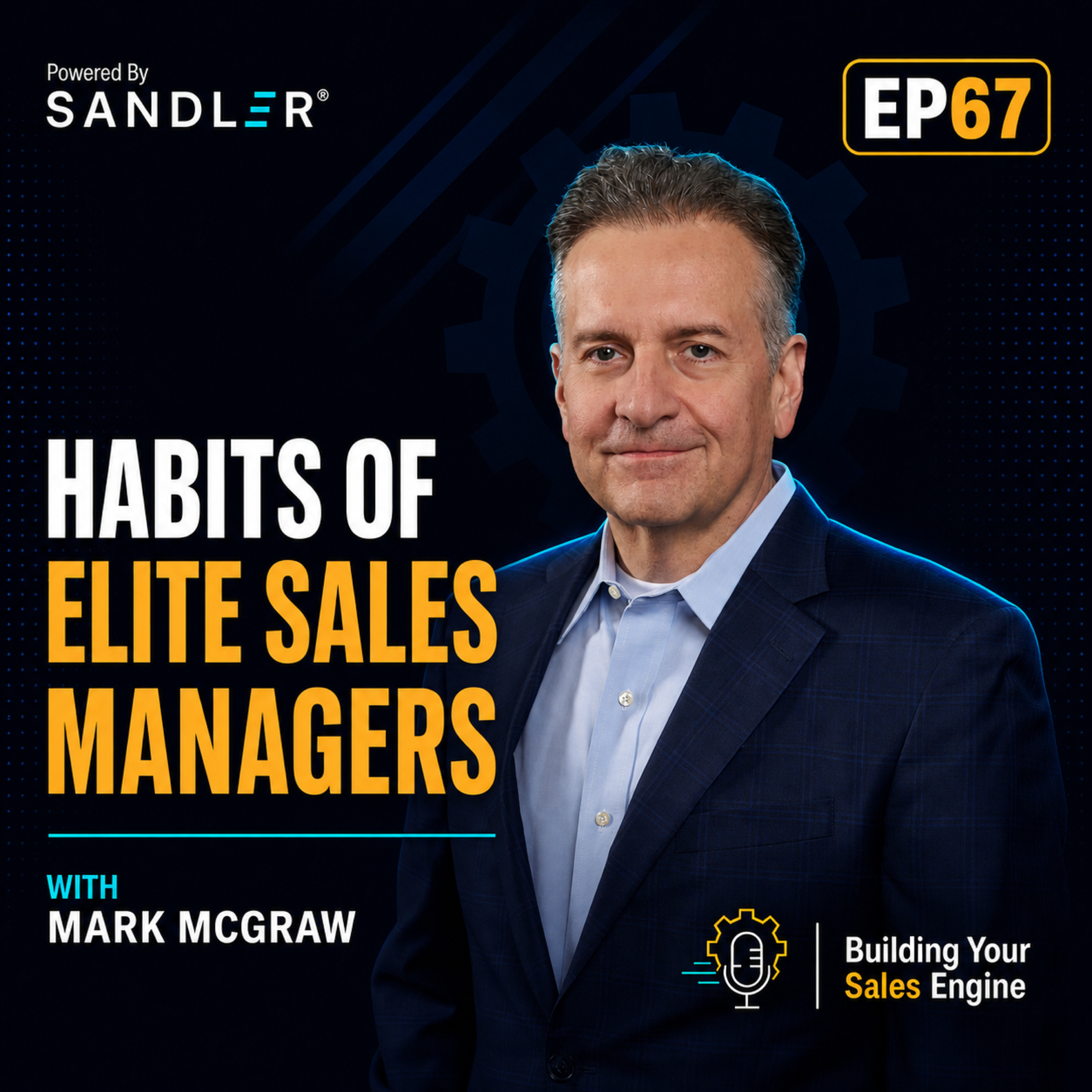
Mark McGraw's Sales Manager Workshop: The Habits of the Elite
The habits of elite sales managers, unpacked in a full workshop replay — how the best sales leaders control their day, coach strategically, and build systems that make their teams self-sufficient. Elite sales managers don't work harder than everyone else — they run a different operating system. In this episode, Mark McGraw shares a full replay of his sales manager workshop on the habits of elite sales leaders, walking through roughly a dozen ideas any manager can put to work immediately. Mark opens with the true story of a manager who elevated 70–80% of the reps he inherited, and unpacks the Three P's of leadership: protection, permission, and potency. From there he goes straight at the biggest killer of sales management performance — time. Managers get interrupted every six minutes and need 23 minutes and 15 seconds to recover, which is why Mark makes the case for Pomodoro-style focus blocks, 90 minutes of protected strategic time each week, and refusing to be your team's answer key. He names the trap: learned helplessness, where over-enabling reps takes them from appreciating your help to being dependent on it. The back half is tools. Strategic vs. tactical coaching. The gap assessment. Running a P&L on a salesperson. The firefighter/arsonist/fire marshal model. The CANI meeting. And why you should record freaking everything and let AI organize it. Host: Mark McGraw — Building Your Sales Engine In This Episode The true story of an elite sales manager who lifted 70–80% of every team he inherited — ride-alongs, self-assessment first, then brutally direct feedback The Three P's of sales leadership: protection, permission, and potency — and why reps follow managers who have all three Why the best sales leaders manage their day instead of letting it manage them, backed by the six-minute interruption stat Pomodoro and focus blocks: 30% more productivity, better quality work, and more energy at the end of the day Learned helplessness — how 100% access trains your reps to stop thinking for themselves Strategic vs. tactical coaching, plus the gap assessment tool that forces honest calibration conversations Blocking 90 minutes a week to look down at the chessboard: territories, revenue per rep, and who needs a plan Running a mini P&L on each salesperson so you can build the business case for expansion Firefighter, arsonist, or fire marshal — which sales manager are you? The CANI meeting, recording everything, and inventorying rep activities to attack the 72% of time spent not selling Links Sandler: https://www.Sandler.com Episode page: https://www.BuildingYourSalesEngine.com/ Show links: https://linktr.ee/buildingyoursalesengine Mark on LinkedIn: https://www.linkedin.com/in/markmcgraw/